
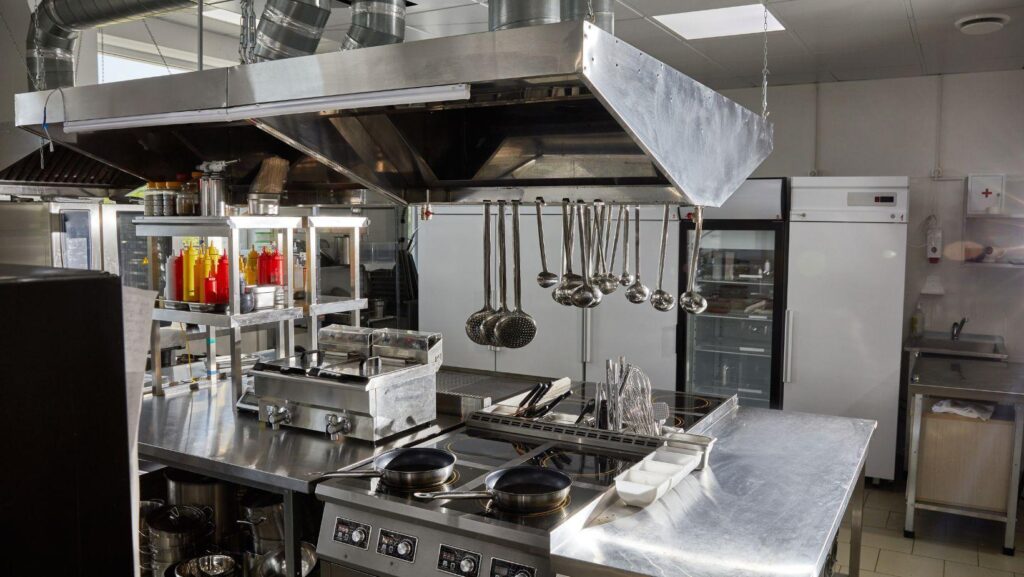
Ghost kitchens — also called dark kitchens or virtual kitchens — are commercial cooking facilities built around a single operational reality: orders come in through delivery apps, food gets prepared and packaged, and a driver picks it up. There’s no dining room, no walk-in customers, and no front-of-house staff. That’s the entire model.
What started as a cost-cutting workaround in high-rent urban markets has matured into one of the fastest-growing segments in food service. The global ghost kitchen market is projected to surpass $100 billion within the next several years, driven by sustained consumer demand for delivery and the significant overhead advantages these facilities offer food operators compared to traditional restaurants.
For engineering and construction professionals, this isn’t background noise — it’s a growing project category that doesn’t fit neatly into standard restaurant construction or conventional commercial kitchen retrofits. Ghost kitchens have their own demands, their own complications, and their own opportunities for builders who take the time to understand what makes them different.
Why Ghost Kitchens Require a Different Construction Mindset
Traditional restaurant construction is a balancing act. Square footage, HVAC zoning, electrical load planning, and plumbing all have to serve two separate environments — the kitchen and the dining room. Ghost kitchens eliminate that balancing act entirely. But that doesn’t make the project simpler. If anything, it concentrates all the complexity of a food service facility into a smaller, more operationally intense footprint.
The kitchen isn’t sharing mechanical and utility resources with a dining room. It is the entire building. That single fact changes nearly every planning assumption construction and engineering teams bring to a typical restaurant project.
Footprint and Space Efficiency
Ghost kitchens are compact by design. Many operators work within 200 to 1,000 square feet, and shared-facility models often pack multiple independent kitchen brands into a single building. This requires construction teams to think carefully about workflow density — how equipment placement, prep zones, cooking stations, and staging areas all interact when there’s no room for inefficiency.
In a traditional restaurant, a cramped kitchen can be partially offset by an open, well-designed dining experience. There’s no equivalent cushion in a ghost kitchen. Every square foot has to earn its place in the operational flow, and that reality needs to drive decisions from the earliest stages of design.
Mechanical, Electrical, and Plumbing Load Intensity
Ghost kitchens often operate at high throughput — serving multiple virtual restaurant brands simultaneously out of a single location — which places significant demand on building systems. Construction and engineering teams should expect conditions that exceed what a comparable dine-in restaurant would require:
- Higher electrical load requirements per square foot, particularly where operators are running multiple high-draw cooking appliances simultaneously
- Ventilation and exhaust systems sized for continuous, high-volume cooking rather than typical restaurant peak periods
- Plumbing designed around commercial dish and prep volume, with limited flexibility in floor drain positioning once walls are closed
This load intensity is especially critical for retrofit projects, which make up a significant share of the ghost kitchen market. Operators frequently target underperforming retail spaces, warehouses, or vacant commercial units because of their lower lease costs. These buildings were never designed to carry restaurant-grade mechanical loads, and a thorough assessment of existing infrastructure before scope development isn’t optional — it’s the foundation of an accurate project budget.
Ventilation Is Consistently the Biggest Engineering Challenge
If one system creates more complications in ghost kitchen builds than any other, it’s ventilation. Commercial kitchen exhaust requirements are demanding under any circumstances, but the locations ghost kitchen operators tend to favor — older buildings, shared structures, dense urban footprints — frequently introduce real constraints around hood placement, duct routing, and makeup air design.
These operators often choose lower-cost real estate, which means buildings with existing duct limitations, structural obstructions, or landlords who have never dealt with Type I commercial exhaust requirements before. Engineering teams that can scope ventilation work early, communicate what’s feasible within a given structure, and identify conflicts before they become mid-project surprises will consistently be more valuable to these clients than teams that treat ventilation as a later-phase item.
Fire suppression integration within hood systems, grease trap positioning, and makeup air unit placement all need to be resolved as part of a coordinated mechanical design. Treating them as separate line items to be addressed independently almost always produces coordination problems that cost time and money to unwind.
Multi-Tenant Ghost Kitchen Facilities Add a Different Layer of Complexity
One of the most common ghost kitchen configurations is the shared or multi-tenant facility, where a single building houses multiple independent food operators, each renting a dedicated kitchen stall. Think of it as a food hall without the seating — each operator has their own brand and prep space, but they share the building’s core infrastructure.
For construction teams, this model introduces coordination challenges that have more in common with a light industrial or multi-tenant office build than a single-operator restaurant project.
Utility Metering and Separation
When multiple tenants are operating simultaneously with their own electrical and water usage, submetering becomes a practical necessity. Each operator needs to be billed accurately for their own consumption, and the base building’s electrical service needs to be designed to handle simultaneous peak loads across all stalls — not just a single kitchen running at capacity. Underestimating aggregate demand at the panel level is one of the more common and expensive mistakes in multi-tenant ghost kitchen builds.
Egress, Fire Separation, and Code Compliance
Shared ghost kitchen facilities often occupy buildings with a prior use type that looks nothing like what’s being built now. Building code compliance — particularly around occupancy classification, fire separation between stalls, and egress requirements — needs to be fully resolved in the permit and design phase, not discovered during inspection. Local jurisdictions vary significantly in how they classify and regulate these facilities. Assuming that one jurisdiction’s approach to ghost kitchen permitting translates directly to another is a consistently costly assumption.
Packaging Storage Is a Practical Design Consideration That’s Frequently Overlooked
Here’s something that doesn’t show up on a mechanical schedule but is deeply embedded in how ghost kitchens actually operate: packaging is the entire customer-facing brand experience. Because customers never set foot inside a ghost kitchen, takeout boxes let you carry your branding into the delivery experience, reinforcing recognition with every order that leaves your location. There’s no storefront, no ambiance, no host greeting anyone at the door. The container, the bag, and the label are the brand.
This has a concrete implication for facility design that builders often miss: packaging storage. Ghost kitchens move through significant volumes of containers, bags, labels, and inserts. Unlike a traditional restaurant where packaging storage is a small afterthought tucked near the expediting station, a ghost kitchen needs dedicated, accessible, and efficiently organized packaging storage as a real part of its operational footprint.
In compact spaces, this might mean built-in shelving integrated into the staging and order assembly area, or a separate storage room with a direct workflow connection to the packaging station. Operators who don’t have this planned from the start tend to solve the problem with stacked boxes in hallways and corners — which creates operational inefficiency and can generate fire code concerns that inspectors won’t ignore.
What Construction Teams Should Establish Before Finalizing a Ghost Kitchen Scope
The ghost kitchen market moves quickly, and operators often come to construction conversations with strong opinions shaped by food service experience rather than construction knowledge. That gap — between what an operator envisions and what a building can support — is where projects go off course. Managing it well from the start is one of the clearest differentiators between construction teams that perform well in this segment and those that don’t.
A few principles apply across virtually every ghost kitchen project:
- Run a thorough existing conditions assessment before any scope is finalized, particularly for retrofits — don’t assume utility capacity, structural loading, or code compliance based on building age or prior use type
- Bring a mechanical engineer into the project early and specifically, with a mandate to define ventilation scope before contract execution — this is the single most common source of scope growth and schedule delay in these builds
- Ask operators directly about their operational model: single brand or multi-brand, expected order volume, and peak throughput assumptions — a kitchen designed for 50 orders per hour has meaningfully different equipment density and utility demands than one designed for 200
- Clarify the permit pathway with the local jurisdiction before committing to a project timeline — ghost kitchen classification and code interpretation varies enough between municipalities that leaving this assumption open puts the schedule at risk
The Competitive Opportunity for Builders Who Develop This Expertise Now
Ghost kitchens are still a relatively new construction category, and the firms that build genuine expertise in them now — understanding the code questions, mechanical demands, retrofit challenges, and space efficiency techniques these projects require — will have a real competitive advantage as demand continues to grow.
The skill set isn’t entirely new. Ghost kitchen construction draws on commercial kitchen work, tenant improvement experience, light industrial retrofitting, and MEP coordination. But it applies those capabilities in a context that’s more compressed, more operationally intensive, and more reliant on getting the details right before construction begins rather than adjusting on the fly.
For engineering and construction teams looking to expand into food service without competing head-on against established restaurant builders, ghost kitchens represent a well-timed market opening. The demand is real, the project pipeline is growing, and the clients — food entrepreneurs moving fast with limited construction knowledge — genuinely need partners who understand what they’re actually building and can help them build it right.