
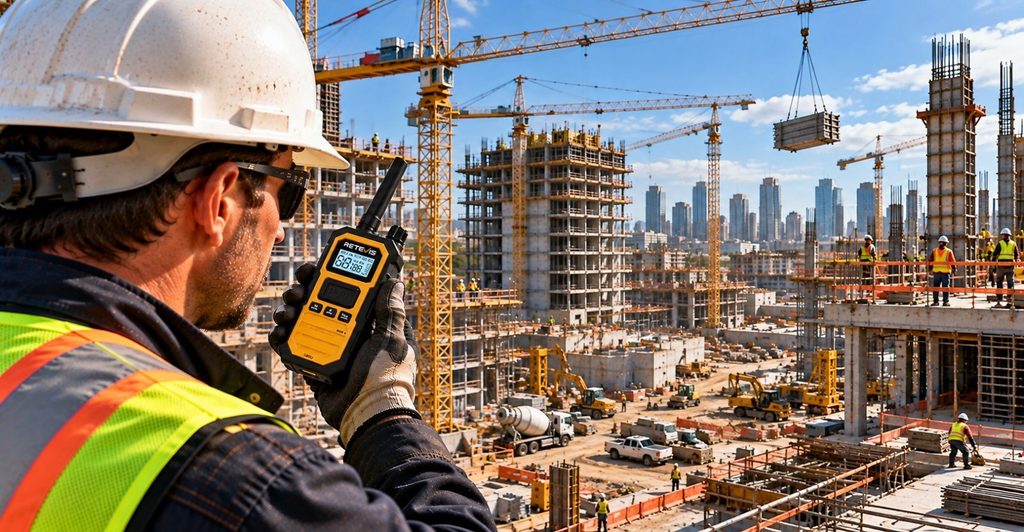
On a large construction project, communication distance is rarely measured in a straight line.
A supervisor may need to reach crews on upper floors, equipment operators at ground level, workers in a material yard and managers inside a temporary site office.
Between them may be concrete, steel, machinery and constantly changing structures.
That is why choosing a long range two way radio system should begin with the jobsite—not a maximum range number on a specification sheet.
Why “How Far Does It Talk?” Is the Wrong First Question
Radio range depends on the environment.
An open outdoor site creates different conditions from a reinforced concrete building. A multi-story construction project creates different challenges from a road or bridge project.
The better question is:
Where does the crew need reliable communication?
Answering that question requires contractors to identify the site’s communication zones.
These may include:
- Ground crews
- Upper floors
- Crane and equipment operators
- Material and loading areas
- Site offices
- Remote sections of the project
Once those zones are understood, potential communication gaps become easier to identify.
Map the Site Before Selecting the System
A practical long-range communication process can follow five steps:
1. Map the Site
Identify buildings, floors, work zones, offices and remote areas.
2. Identify Communication Paths
Determine which teams need to communicate with each other during normal operations.
3. Find Potential Coverage Gaps
Consider distance, concrete, steel, elevation and other physical barriers.
4. Select Handheld Equipment
Choose radios based on communication requirements and environmental conditions.
5. Add Repeater Support Where Needed
Where handheld-to-handheld communication is insufficient, repeater-supported coverage can become part of the system.
This changes the buying logic from:
“Which radio has the longest range?”
to:
“Which system provides the coverage this operation requires?”
Handheld + Repeater + Coverage Planning
RETEVIS approaches long-range professional communication as a system.
Professional handheld radios such as RETEVIS RT29S can support teams that need longer range communication, while rugged products such as RETEVIS RB48 Plus are designed for demanding work environments.
For sites where direct handheld communication does not provide sufficient coverage, RETEVIS RT97L portable repeater can support a broader deployment.
But there is no universal configuration for every construction site.
A high-rise project, industrial complex, warehouse development and road construction project may all require different deployment approaches.
The solution needs to follow the environment.
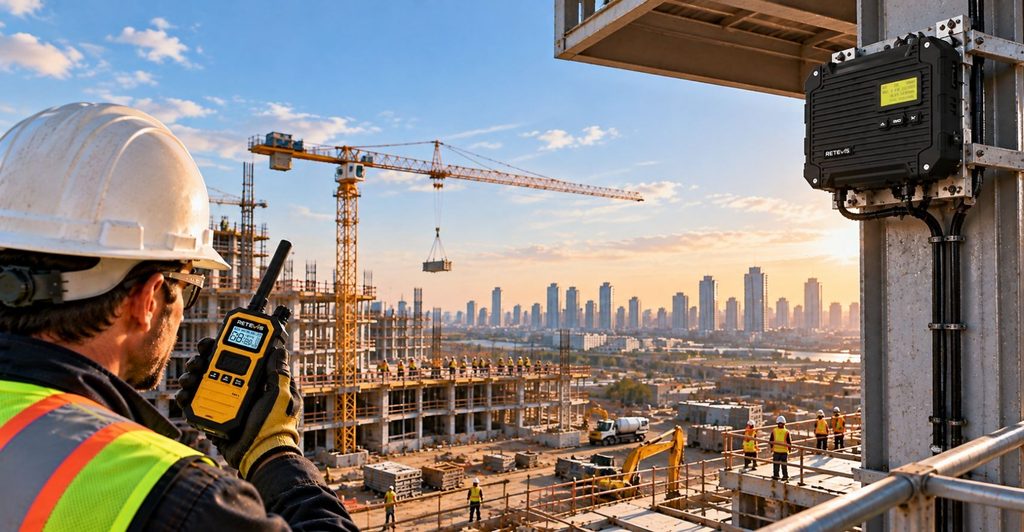
Reliability Has Three Layers
Long-range communication also illustrates why RETEVIS is expanding its definition of reliability.
Reliable Jobsite Communication = Equipment Reliability + Coverage Reliability + System Reliability
Equipment Reliability asks whether radios can withstand the work environment.
Coverage Reliability asks whether communication reaches the required areas.
System Reliability asks whether the overall deployment supports the people and workflows that depend on it.
A rugged handheld radio alone cannot solve every coverage problem.
Likewise, a repeater cannot compensate for equipment that is unsuitable for the environment.
Reliable communication requires the pieces to work together.
Why Coverage Matters Operationally
A communication gap may result in more than a missed conversation.
A worker may need to walk across the site to locate a supervisor. Instructions may be repeated. Equipment operators may wait for confirmation. Material movement may pause while teams reconnect.
Across a large project, these interruptions can accumulate.
Reliable communication therefore supports more than radio performance.
It supports coordination.
The Next Chapter of Reliable Construction Communication
After 16 Years of Reliable Connections, RETEVIS is extending its focus from reliable individual products toward industrial standards and scenario-based communication solutions.
Large construction sites are an important example of that transition.
The future is not simply about increasing radio range.
It is about understanding the site, identifying the communication requirement and building the appropriate system around it.
RETEVIS will bring this approach to PMRExpo 2026 in Cologne, November 24–26, where professional users can explore communication products and solutions for complex operating environments.
For large construction projects, the principle can be summarized simply:
Reliable communication isn’t about the longest range. It’s about making sure the connection reaches where the job needs it.